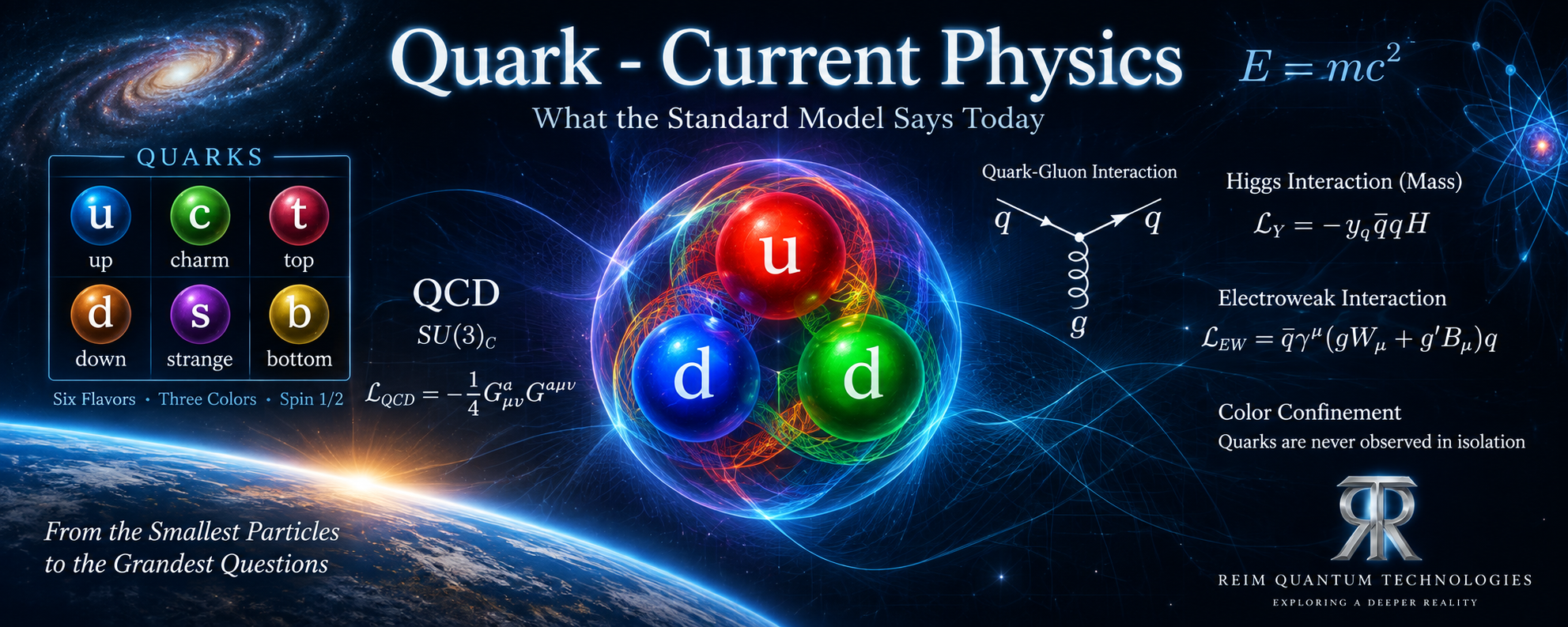
I asked ChatGPT this question:
What does current physics think a quark is and how does a quark interact with either of the fields (Higgs field or gauge fields)?
ChatGPT Answer: Current physics makes a surprisingly modest claim about what a quark is internally: in the Standard Model, a quark is treated as elementary. No smaller constituents or internal structure have been experimentally established. More precisely, quantum field theory describes a quark as an excitation of a quark field, not as a little hard object with known machinery inside it.
That distinction is especially useful for what you’re investigating.
What properties does a quark have?
There are six quark flavors:
Every quark is a spin- fermion and carries several kinds of quantum numbers. Most importantly here, it carries:
- color charge → couples it to the gluon field,
- electric charge → couples it to the electromagnetic field,
- weak quantum numbers → couples it to the electroweak fields,
- Yukawa coupling → couples its left- and right-handed components through the Higgs field.
So a quark isn’t interacting with just one field. It’s participating in several quantum fields simultaneously. The Standard Model organizes these interactions through
1. Quark ↔ gluon field
This is probably the most important interaction for understanding a quark inside a proton or neutron.
A quark possesses color charge. Consequently it couples to the gluon field of quantum chromodynamics (QCD).
Schematically:
and another quark can absorb that gluon:
But that cartoon shouldn’t be interpreted too literally as tiny balls shooting smaller balls at one another. In QFT these are interacting quantum fields.
There are eight gluon fields, and because gluons themselves carry color charge, gluons also interact with other gluons. That’s a fundamental difference from ordinary electromagnetism.
This interaction is extremely important because it leads to confinement: isolated quarks aren’t observed under ordinary conditions. Instead we observe color-neutral combinations such as baryons and mesons.
For a proton, therefore, the simple schoolbook picture
isn’t the complete physical state. The proton contains interacting quark and gluon fields, including sea-quark contributions.
2. Quark ↔ electromagnetic field
Because quarks have electric charge,
while
they also couple to the electromagnetic gauge field—the photon.
Schematically:
So quarks participate in electromagnetism just as electrons do, although their electric charges are fractional.
3. Quark ↔ weak gauge fields
Quarks also participate in the weak interaction through the and .
And here something particularly interesting happens:
is possible.
That means the weak interaction can change quark flavor. This is what lies underneath processes such as beta decay.
For example, very schematically,
One of the neutron’s down quarks has effectively become an up quark through the weak interaction.
The left-handed and right-handed pieces of the quark do not participate identically in the electroweak interaction. The Standard Model is explicitly a chiral theory.
And that brings us to the Higgs.
4. Quark ↔ Higgs field
This is fundamentally different from gluon exchange.
The Higgs field has a nonzero vacuum value:
A quark has a Yukawa interaction with the Higgs field. In simplified notation,
Notice something important:
The Higgs coupling connects the left-handed and right-handed quark fields.
Once the Higgs field acquires its vacuum value, this interaction produces a quark mass term approximately
Different quarks have different Yukawa coupling strengths , which is why their masses are enormously different. The top quark couples very strongly to the Higgs; the up and down quarks couple extremely weakly. Higgs interactions with top, bottom and charm quarks have been experimentally probed, with the heavier fermions showing the expected stronger couplings.
There’s a subtle but important correction to the popular statement “the Higgs gives matter its mass.”
It gives the quarks their elementary/rest-mass parameters, but most of the mass of a proton or neutron does not simply equal the Higgs-generated masses of its three valence quarks. Much of a nucleon’s mass arises dynamically from QCD—the energy associated with the strongly interacting quark/gluon system.
Now the part I think is particularly relevant to our discussion
There are really two very different categories of quark interaction:
versus
That second line is worth keeping on our whiteboard.
Because the Standard Model doesn’t provide a little mechanical model inside the quark explaining what physically “turns” a left-handed quark field into a right-handed one. It specifies the interaction mathematically through the Yukawa coupling and Higgs field, and that mathematics works extraordinarily well experimentally.