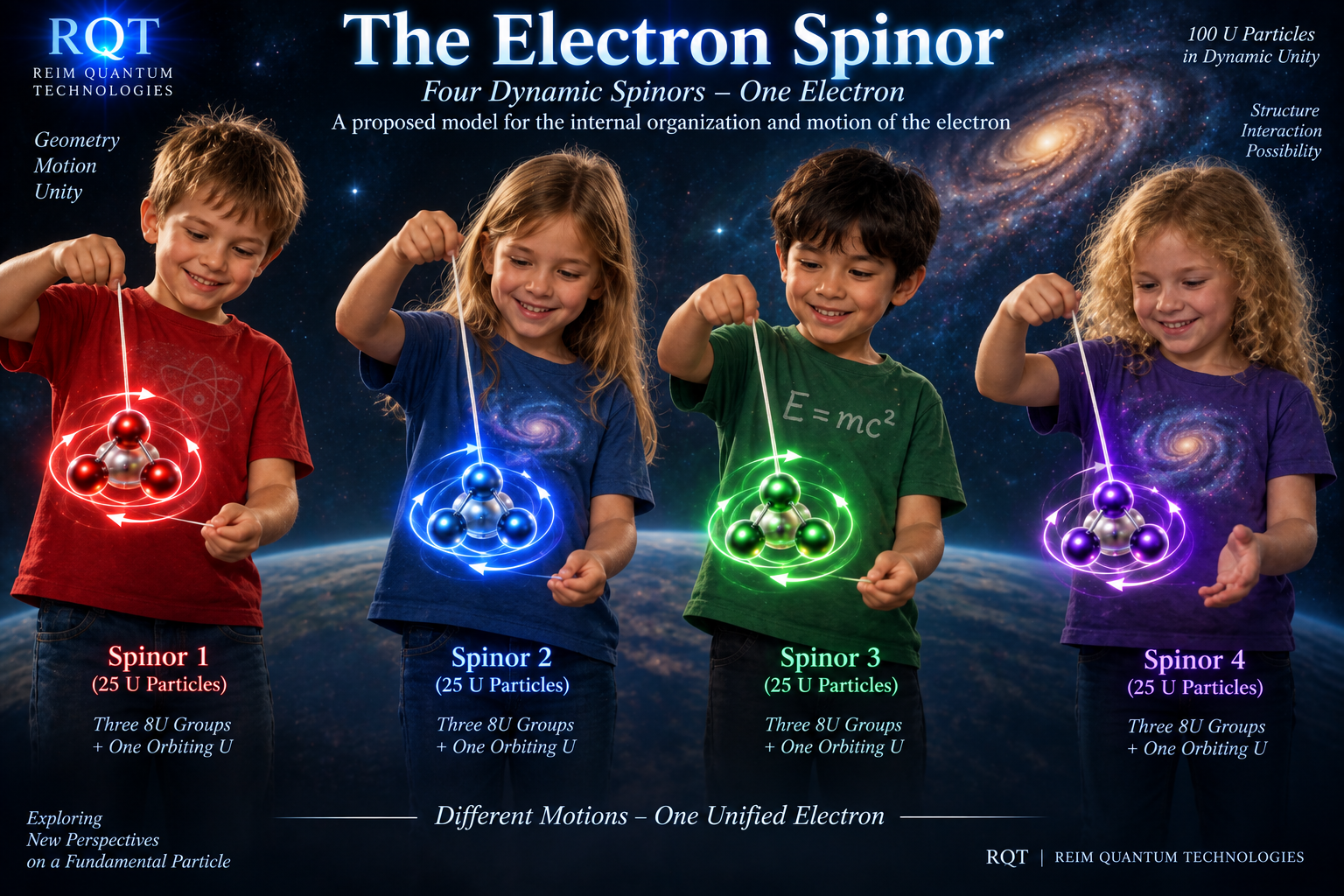
A proposed dynamic model for the internal organization and motion of the electron
By combining the four-spinor Dirac concept of the electron with the spinor diagrams presented by Nigel Nunn, and considering the statement in The Urantia Book that the electron is composed of exactly 100 ultimatons—or what I refer to as “U Particles”—we can begin exploring possible dynamic models for how such a structure might move and interact. These proposed models are developed while keeping the established principles and observations of current physics firmly in view.
From One Spinor to Four
The animation above represents only one proposed 25U spinor. To visualize the complete RQT electron model, imagine four of these spinors stacked together like four coins in a coin holder, with Spinor 1 at the bottom and Spinor 4 at the top. Each spinor contains its own three 8U groups and circulating 25th U Particle, but the four spinors need not operate in identical phase.
One possible arrangement is for Spinors 1 and 3 to operate 180° out of phase. At the instant the 25th U Particle of Spinor 1 reaches its coupling position along the 0° direction, the 25th U Particle of Spinor 3 reaches the corresponding position along the 180° direction. In the RQT model, these simultaneous but opposing alignments are proposed to produce complementary regions of local field relaxation.
The second pair, Spinors 2 and 4, can then be oriented 90° from the first pair. At their corresponding coupling event, their 25th U Particles occupy opposing positions along the 90° and 270° directions. The sequence therefore alternates between the 0°–180° pair and the 90°–270° pair as the four spinors continue their motion.
The proposed result is not a static balance, but a continuously changing, dynamically balanced configuration: while one opposing pair reaches maximum alignment and local field relaxation, the other pair is progressing through another part of its cycle. The process then reverses and repeats. Whether such a four-spinor phase relationship can reproduce the measured properties of the electron remains a question for further development and quantitative testing of the RQT model.
Proposed Interaction with Quantum Fields
In current physics, particles are described through their interactions with quantum fields. The electromagnetic field is associated with electric charge and electromagnetic interactions; the Higgs field is associated with the mechanism that gives elementary particles their rest-mass terms through their Higgs interactions; and the weak interaction is described by the electroweak fields associated with the W and Z bosons. In the RQT model, we propose that the continual motion of the U Particles may interact dynamically with these existing fields rather than requiring an entirely new field. As an 8U group moves outward toward its maximum extension, the surrounding field configuration can be envisioned as progressively relaxing; when the circulating 25th U reaches the vacant position and temporarily completes the symmetrical 3+3+3 configuration, the local field configuration reaches its most relaxed state. As the particles continue their motion away from this alignment, the field becomes progressively distorted or “wound” again. The animation does not attempt to depict these fields directly; it illustrates the proposed particle motion from which such changing field interactions might arise.
A Model to Explore
The purpose of this proposed model is not to replace the successful mathematical descriptions of the electron used in current physics, but to explore whether an underlying dynamic structure might provide another way of visualizing some of the properties those equations describe. By combining the established concepts of spinors and quantum fields with Nigel Nunn’s spinor interpretation and the 100-Ultimaton description found in The Urantia Book, RQT has developed one possible dynamic arrangement that can now be examined more closely. The model presented here should therefore be viewed as a working hypothesis—one that must ultimately be compared with the known quantitative properties of the electron and modified or rejected wherever it fails those tests.