Understanding the Inner Atom Table
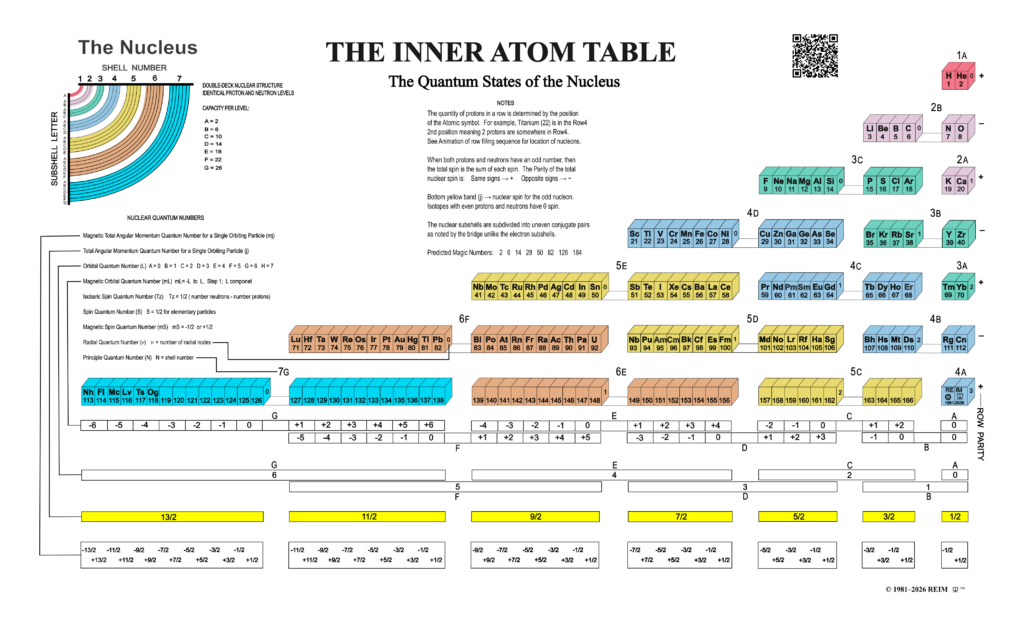
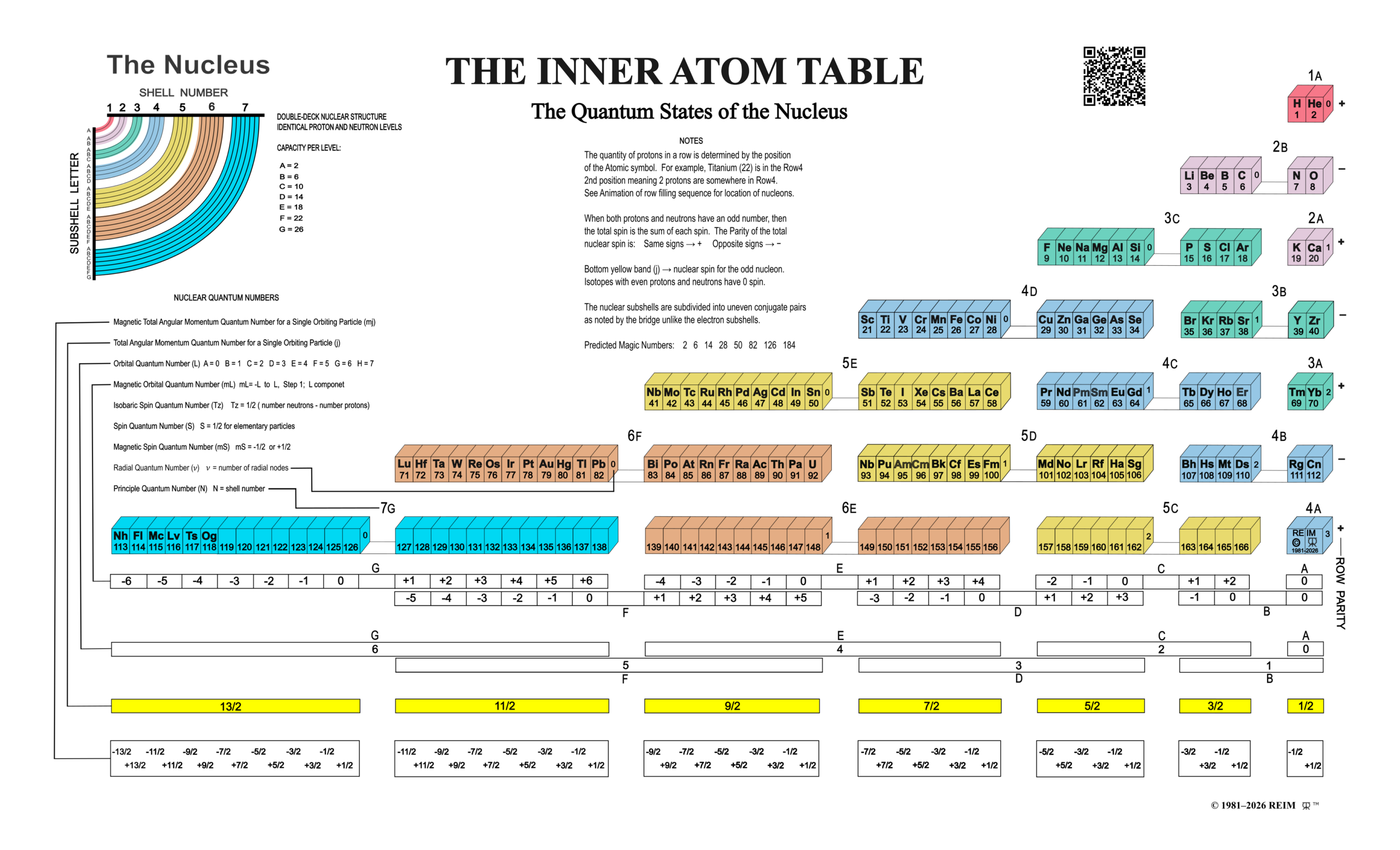
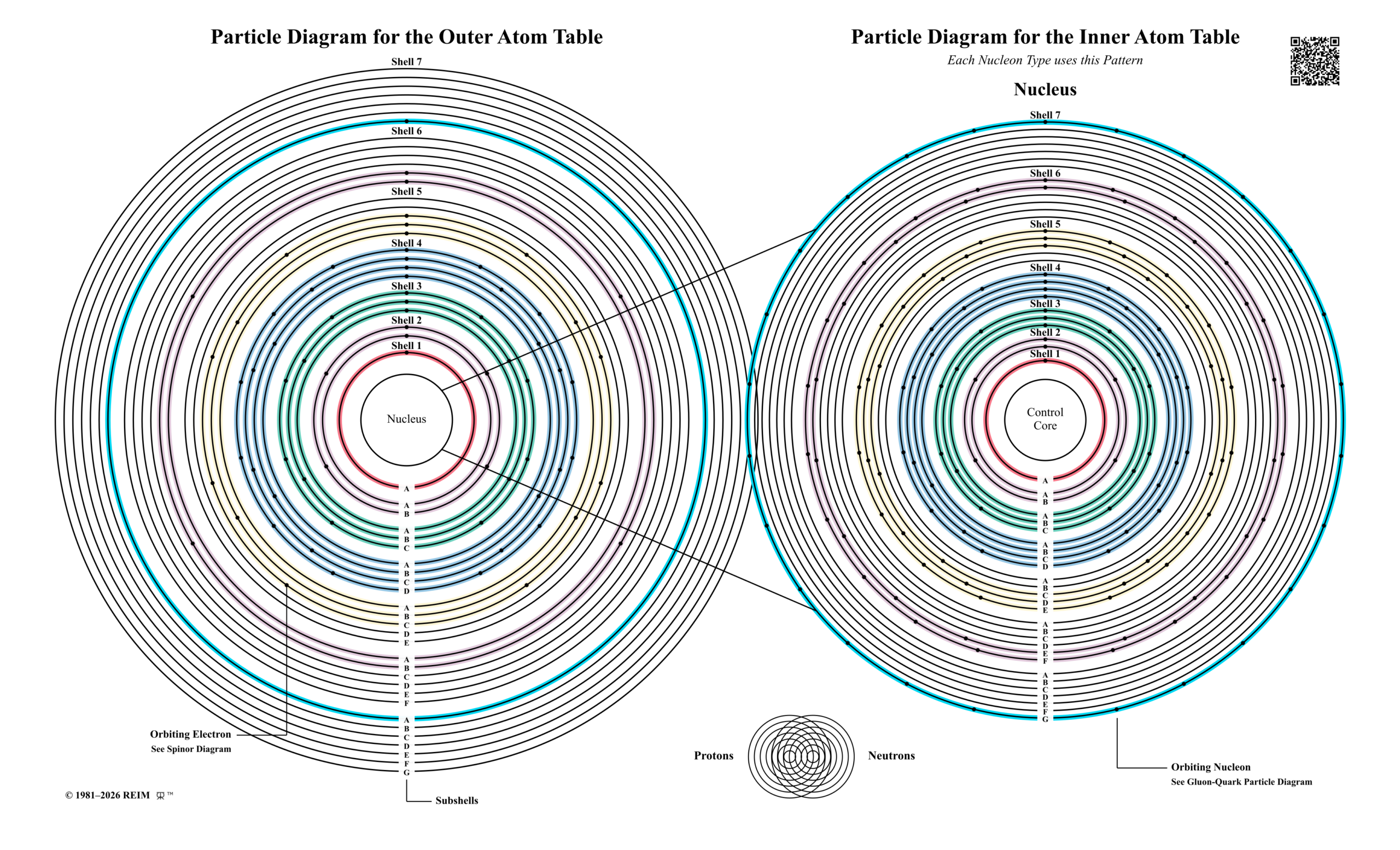
The Inner Atom Table shows how the nucleus of the atom can be organized using Shells, Subshells, orbitals, and spin, similar to the electron structure shown on the Outer Atom Table. However, the nuclear Subshells are also divided into uneven conjugate pairs, as indicated by the bridges between the block groups.
The 1/4 Colored Ring Diagram in the upper corner helps the student understand the relationship between the Shell/Subshell rings and the colored block groups. The chart is used twice: once to determine the quantum states of a proton and again for a neutron.
In the IAT system, each nucleon (proton or neutron) is described using a total of 9 quantum states plus parity. A list of these 9 quantum numbers is shown on the left side of the chart, while several of their corresponding values are shown along the bottom. The parity of each row is shown at the far right, where the rows alternate between + and −.
One quantum number at the bottom of the chart has been highlighted in yellow because it plays an especially important role in determining the total nuclear spin of an isotope.
Figuring Out How the Pieces Move
I like to treat these charts like game boards. The trick is figuring out how the pieces—in this case, the protons and neutrons—move across the board.
The experimental data I used to work out the filling sequence was the measured nuclear spin of isotopes. Because an even number of protons combined with an even number of neutrons produces a total nuclear spin of zero in the cases being considered, the useful clues came from isotopes having an odd number of protons, an odd number of neutrons, or both.
I worked out the basic filling pattern more than 10 years ago. It took considerable experimentation, comparing the chart against the measured nuclear spins of more than 200 isotopes.
But one important piece was still missing: parity.
This year, while working with ChatGPT, I recognized the significance of the alternating + and − rows and developed two filling rules depending upon the parity of the row. This becomes especially important for isotopes having both an odd number of protons and an odd number of neutrons.
The resulting filling sequence is a complex cascade that is very difficult to explain using words alone. I therefore worked with ChatGPT to turn my filling rules and descriptions into an animation so the student can actually watch the conjugate-pair filling occur.
The Double-Deck Animation
The animation at the bottom of this page demonstrates the cascade-type filling sequence for protons and neutrons.
I use a double-deck design: protons fill the upper deck while neutrons fill the lower deck. This makes it much easier to see the relationship between the two filling sequences.
Rather than filling the entire chart at once, the animation fills several rows and then pauses so the student can examine the emerging pattern. It then continues through additional rows and pauses again. This allows the student to learn the sequence in stages instead of trying to absorb the entire pattern at once.
Actual isotopes are then introduced to show exactly where their protons and neutrons are located. I begin with isotopes having even numbers of both protons and neutrons. From there, the examples progress to isotopes having an odd proton or an odd neutron, allowing the student to see how the measured nuclear spin relates to the filling sequence and the two rules introduced in the animation.
The electron-filling approach represented by Hund’s Rule does not describe the nuclear filling sequence represented on the Inner Atom Table. A different set of rules is required.
What About the Exceptions?
Just as exceptions occur in electron filling, I have also found exceptions when applying the two IAT nuclear filling rules.
The basic filling sequence works well through approximately the first five or six rows. Beyond that point, some interesting deviations begin to appear.
I have been working with ChatGPT to examine these unusual measured spin values, and patterns appear to be emerging among the exceptions themselves. Nuclear states can also change under excitation, adding another level of complexity that deserves its own investigation.
That will have to be a future topic.
For now, the goal of this page is simpler: teach the basic filling pattern and give the student a visual way to understand an already complex arrangement of protons and neutrons.
This animation is a double-deck version of the Inner Atom Table to show the filling of the protons on the upper deck and filling of the neutrons on the lower deck. Example of individual isotopes are also shown. The user can see how the Nuclear Spin for an isotope is determined.
© REIM 1981–2026. Free for personal and classroom educational use. Not for resale, redistribution, modification, or commercial reproduction without permission.