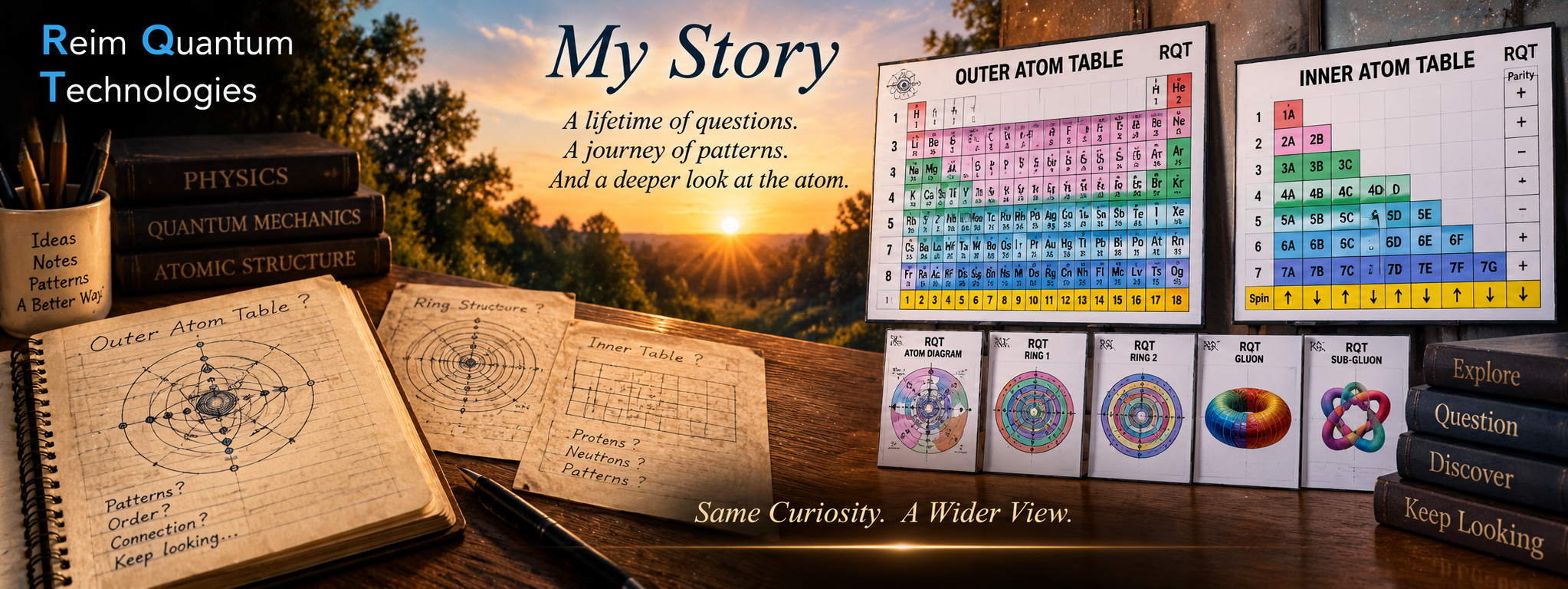
My Story:
My name is Dick Reim, and I am a retired electrical engineer who has spent much of my life studying patterns, systems, and how things fit together. Over the years, that curiosity led me to develop the Outer Atom Table, the Inner Atom Table, and the other diagrams presented on this website.
How It Began:
While taking a Chemistry class at UCF in the late 70s, I had a test on Quantum Numbers coming up. My book was terrible in explaining Quantum States, so I began experimenting with the electron filling sequence which resulted in a 2-dimensional number pattern that I could understand. I then was able to change the numbers into blocks which was the beginning of a new chemistry table pattern based on the electron filling order of the subshells. The new chemistry table was initially called the Quantum Table, then over time the Reim Quantum Table, then finally The Outer Atom Table (OAT). Why “Outer” you say? Well, the story continues.
After graduating in 1981 with an Electrical Engineering degree, I was able to score a job at Martin Marietta (now called Lockheed Martin). I had shown all the Engineers my new chemistry chart. A few years later, my boss told me that the protons and neutrons are also in orbits within shells and subshells. I was floored. None of my Engineering classes mentioned this. My boss had a PhD in nuclear physics, so I ask to borrow his nuclear books which I took home to investigate this new knowledge. I found the chapter on Nuclear Quantum States and applied my same principles as I did to create the OAT. It was a dead end. I then saw how the subshells within the nucleus were split into these uneven conjugate pairs, so I began looking for patterns based on conjugate pairs and found a 2-dimensional number pattern that worked. I changed the numbers into blocks which created the Nuclear Quantum table which I have now renamed to the Inner Atom Table (IAT).
Both the OAT and IAT are like game boards. You have to know how to move the pieces on the boards. For the OAT, the Hund’s Rule has been known for decades which allows the student to derive the 4 quantum numbers for the last filled electron for any element. There are several exceptions to Hund’s Rule, so I had to create 4 rules to account for these odd-ball elements. Both of these charts have the subshell notations modified from the current s, p, d, f to a more standard A, B, C, D, E… notation to prevent confusion for the higher-level subshells within the nucleus.
The IAT was way more complex with its 9 Quantum States for each Proton or Neutron. There was no “Hund’s Rule” for the nucleus, so I had to figure out how the pieces moved on the game board using the only thing available, the known Nuclear Spin for the isotopes. But half of the data was missing because an even number of protons and neutrons produce a zero spin. I finally found the filling pattern for the nucleons around 2010. It was a complex, cascade type filling sequence that started on the right side of every row. I created an animation to show this filling pattern. The filling sequence predicted the Nuclear Spin of most of the isotopes but needed a few rules since each row alternated parity. However just like the electrons, there are exceptions to this filling sequence and most of the exceptions occur for the heavy isotopes.
After presenting my two charts at the Urantia Science Symposium in 2016, fellow researcher Nigel Nunn suggested that if I wanted to investigate patterns deeper within the atom, there might be no experimental data available to reveal them directly and I would have to work backwards and search for the patterns themselves. Nigel was right. Using similar number-sequencing principles, I eventually found two additional patterns, which became the Gluon-Quark Table and Sub-Gluon Table, completed in 2026.
Unlike the OAT and IAT, which were developed from established electron and nuclear quantum-state data, these two new tables are theoretical. An important part of this investigation comes from The Urantia Book. It describes an ultimate particle called the Ultimaton (U) and states that 100 Ultimatons make up one electron. It also describes these particles at a level of matter beyond our present means of direct detection.
I combined that information with another intriguing feature of established physics: Dirac’s relativistic description of the electron uses a four-component spinor. This led me to investigate whether the 100U electron described in The Urantia Book could have a four-part physical construction—four 25U spinor units that Nigel Nunn suggested.
Using this 100U, four-spinor model, I then examined the electron-proton and electron-neutron mass relationships. The resulting ratios are extremely close to the experimentally measured values. This relationship between the 100U description, Dirac’s four-component spinor structure, the four 25U construction, and the numerical mass ratios is one of the principal reasons I believe this model deserves further investigation.
Later, on the technical Gluon-Quark/Sub-Gluon pages, we can show the actual mass-ratio calculations and let the numbers speak for themselves.