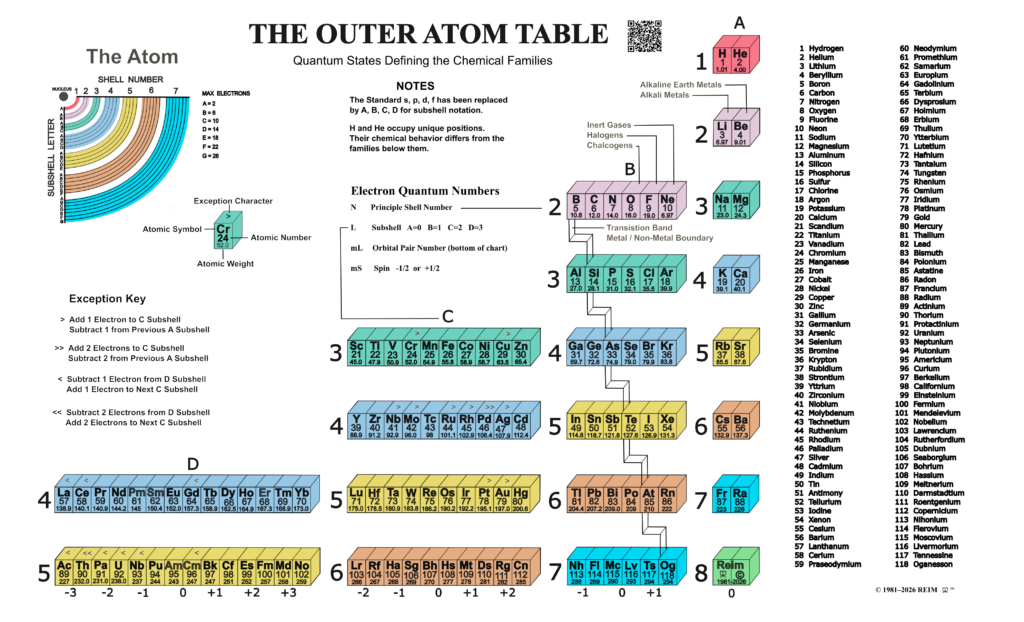
The Outer Atom Table can be used as a chemistry table since the chemical families still align vertically. Hydrogen and Helium are exceptions to this arrangement. Hydrogen is an active gas and does not behave like an Alkali metal, while Helium behaves like an inert gas.
Students get an extra benefit from this chart because the pattern of the chart is the pattern of the order in which electrons fill the Subshells of an atom. Confusion over the traditional s, p, d, and f labeling goes away when the Subshells are relabeled A, B, C, and D. This becomes especially useful when students encounter the more complex Inner Atom Table, where the Subshell labels continue through E, F, and G.
The first video on this page begins with the Periodic Table of Elements, first published in 1869—yes, it’s that old!—and then transforms its blocks into the Outer Atom Table. As the transformation occurs, you will see that most groups of blocks remain together, showing how the chemical families are largely preserved in the new arrangement.
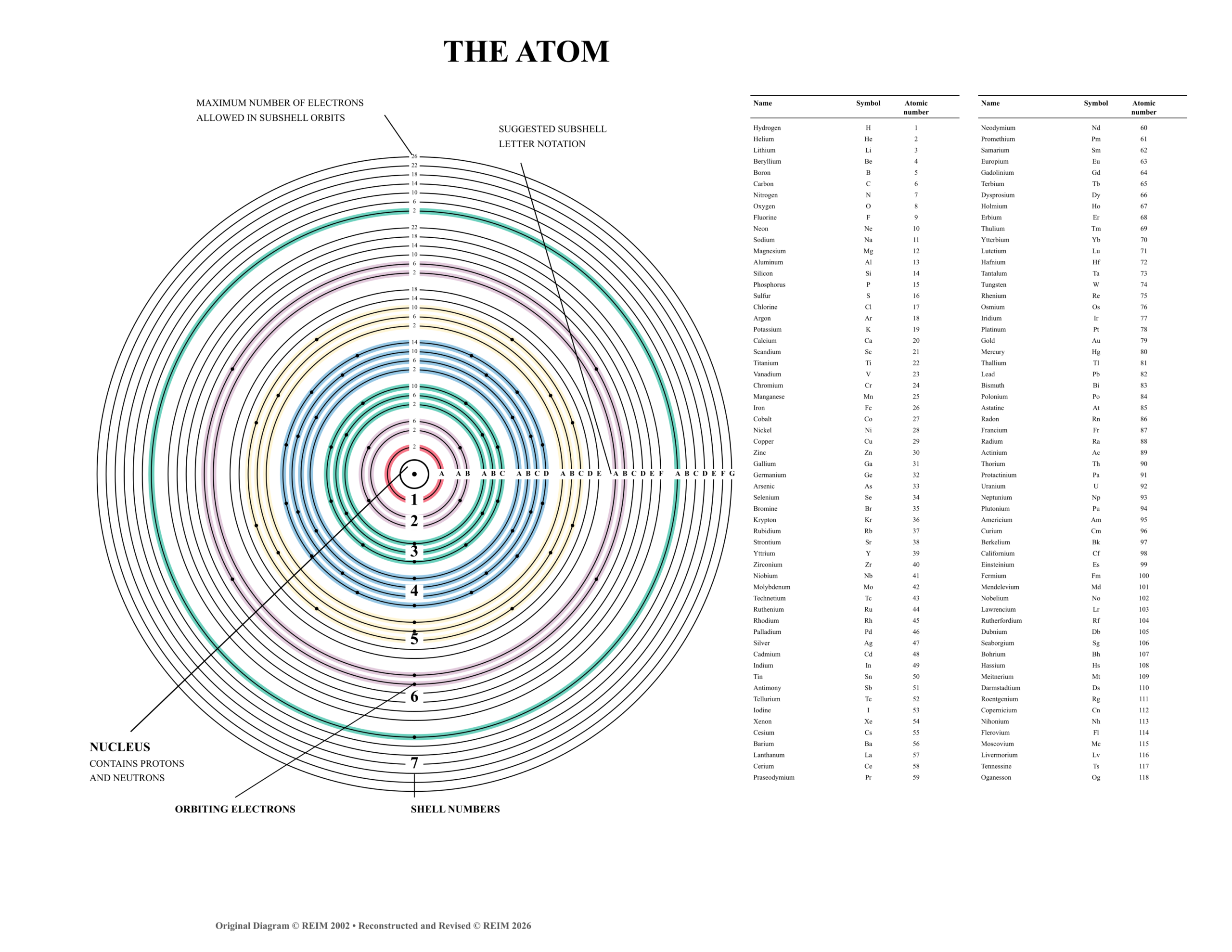
Next, an atom diagram appears showing rings that represent the electron Shells and Subshells. The rings are arranged into groups called Shells. Within each Shell, the individual rings are labeled A, B, C, D, etc., representing the Subshells. The video then demonstrates how these initially empty Subshells are progressively filled with electrons as you move through the chart. Subshells containing electrons become colorized, while Subshells that have not yet been filled remain black.
At this point a student might say, “Hey, the order of Subshell filling doesn’t simply start with the innermost ring and work outward. It follows a pattern.”
Exactly! And that pattern is one of the keys to understanding atomic structure. The Outer Atom Table IS that pattern.
Camp Q:
I like to teach younger students that the electrons are like kids going to camp and each kid has an assigned cabin to sleep in. The cabins would be numbered 1, 2, 3, 4, etc. I would explain that Cabin 1 only has 1 bedroom, Cabin 2 has 2 bedrooms, Cabin 3 has 3 bedrooms, and so on. I would then explain each bedroom would have a letter of A, B, C, D, etc. on the door of the bedroom. I would then tell them that each bedroom would have bunkbeds to sleep in. Bedroom A would only have 1 bunk bed. Bedroom B would have 3 bunk beds. Bedroom C would have 5 bunk beds. Bedroom D would have 7 bunk beds. The single bunk bed in Bedroom A would be labeled “0”. The three bunk beds in Bedroom B would be labeled -1, 0, +1. The five bunk beds in Bedroom C would be labeled -2, -1, 0, +1, and +2 etc. I would then explain that each kid had to pick their bunk bed to sleep in but everyone always wanted to sleep on the top bunk, so for example in bedroom B where there are 3 bunk beds, the first kid enters the room and picks bunk bed -1 and takes the top bunk. The next kid enters and he wants a top bunk too, so he has to go in order, so he picks the top bunk of bunk bed 0. The third student enters the room and also wants a top bunk so the only one left is the top bunk for bunk bed +1. The fourth kid enters Bedroom B and is bummed out because all the top bunks are taken so he must take the bottom bunk of bunk bed -1. The next kid takes the bottom bunk of bunk bed 0 while the last kid takes the bottom bed of bunk bed +1. I then explain that this is exactly what the electrons do except if you are on the top bunk, you can spin around CCW which is also called the -1/2 spin for electrons. I explain that all the kids on the bottom bunk can spin around CW which is also called the +1/2 spin for electrons. I then explain the bunk beds are called orbitals for electrons. The bedrooms are called Subshells for electrons. The cabin is called the Shell for electrons. This way a student can correlate a real-world situation for what the actual electrons are doing within an atom.
Determining the Quantum Numbers:
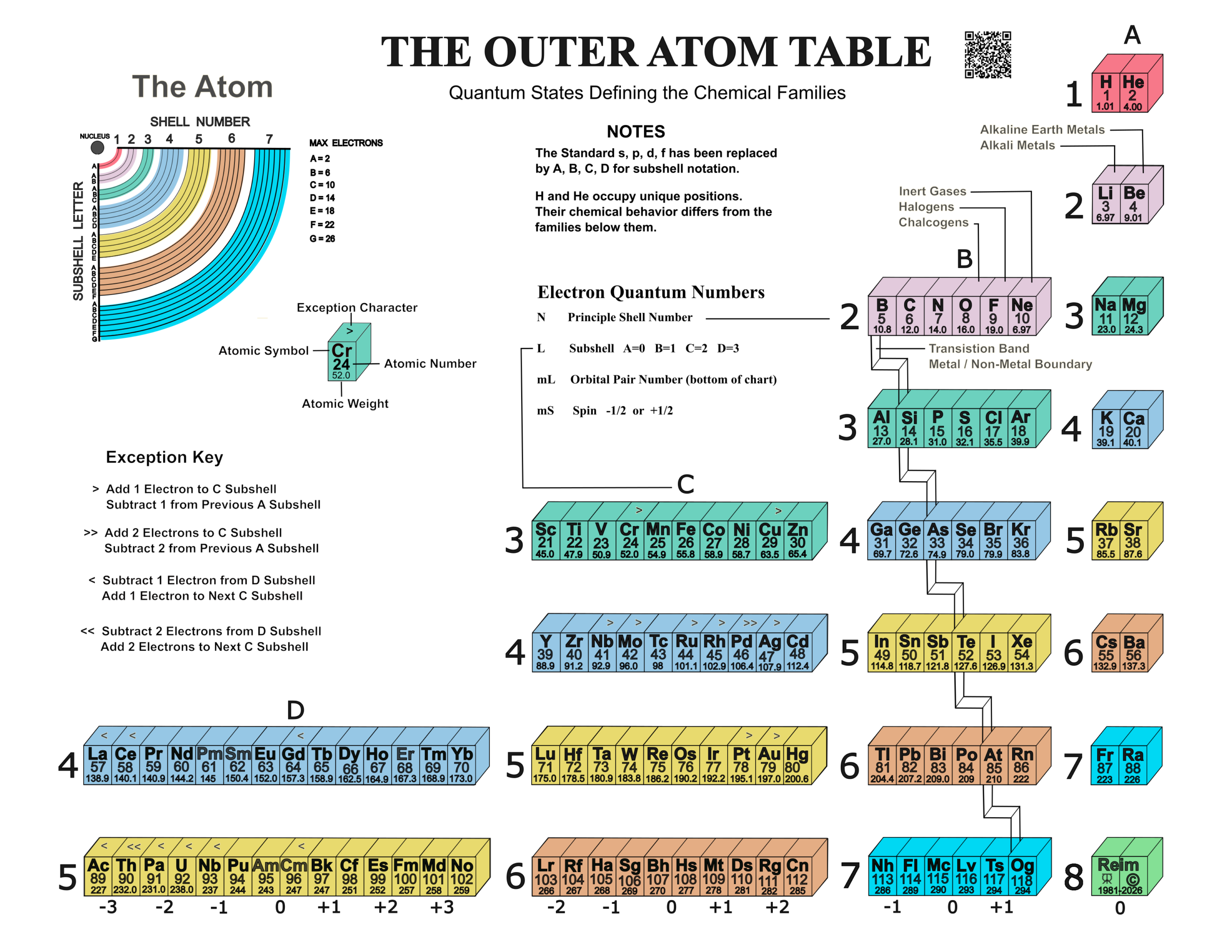
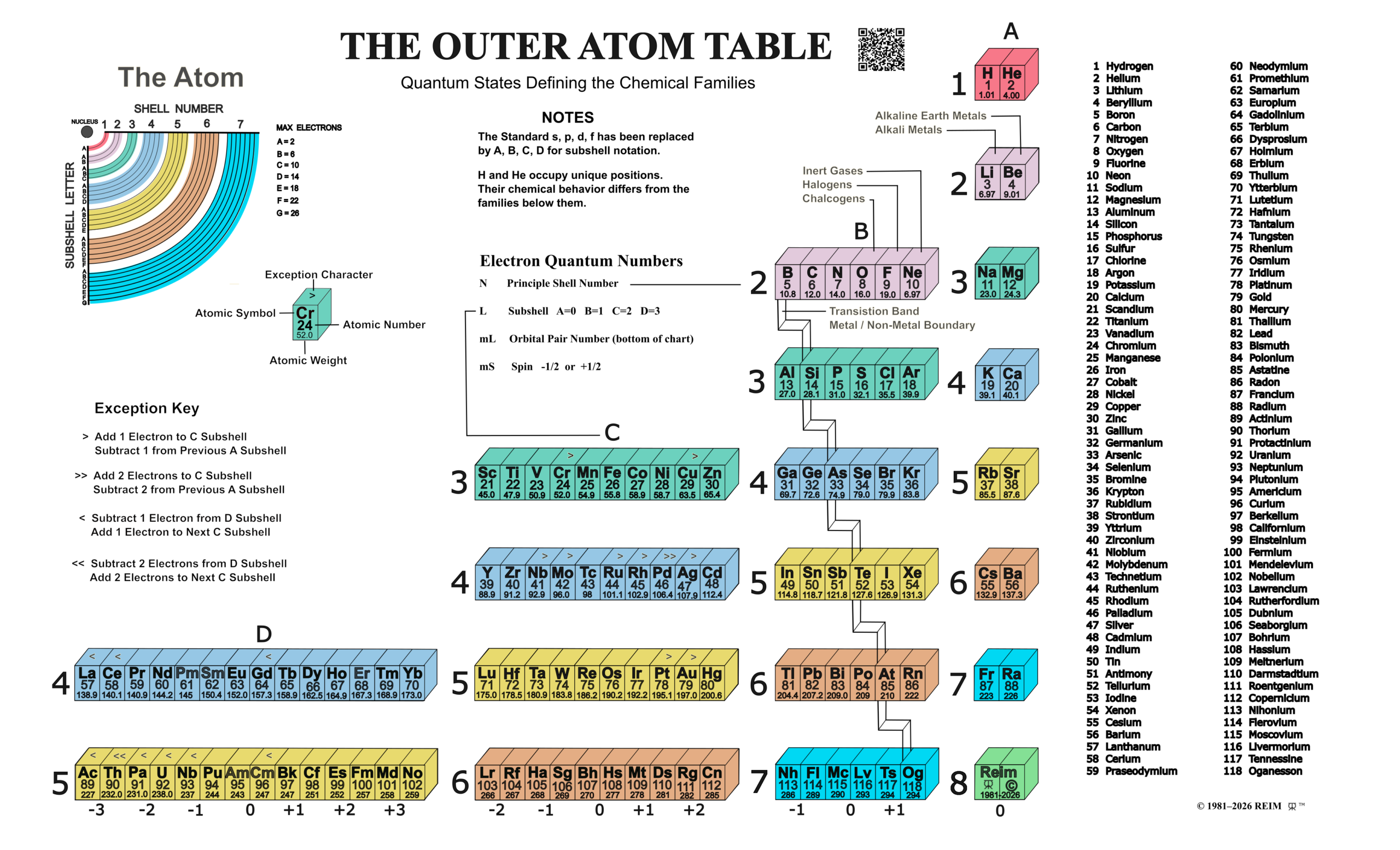
So, to figure out the 4 quantum numbers of an electron, you just need to know which Cabin, which bedroom, which bunk bed, and am I on the top bunk or bottom bunk. This is the Shell, Subshell, orbital, and spin values of an electron. So, when your chemistry professor wants you to know the 4 quantum numbers of Nitrogen, what he is really saying is Nitrogen has 7 electrons, but I just want to know where that 7th electron is located, and which way is the spin. So, as you look at the Outer Atom Table you can see Nitrogen (N) in the 7th block which is located in the 2B Subshell. Now just ignore all the element symbols in all the other blocks like they are not there and concentrate only on the blocks themselves. The 2 is the Shell the 7th electron is in. The B above the blocks is the Subshell the 7th electron is in (reference: A=0, B=1, C=2, and D=3) which is a Subshell quantum number of 1. Since we just talked about bunk beds, you can see at the very bottom of the chart, below all the B Subshells, the orbital numbers -1, 0, and +1 which are the bunk beds. We know since Nitrogen sits in the third block of the 2B Subshell, this means the Nitrogen atom has 2 of its electrons in the 1A Subshell, 2 of its electrons in the 2A Subshell, and 3 of its electrons in the 2B Subshell or electrons 5, 6, and 7. It is that 7th electron that gives and answer to the professor’s question. So, we can say that electron 5 took the top bunk of bunk bed -1, electron 6 took the top bunk of bunk bed 0, and the 7th and final electron (the key) took the top bunk of bunk bed +1. And we know anyone on the top bunk spins CCW or -1/2. So, the four quantum numbers of that 7th electron for Nitrogen are 2 (Shell), 1 (Subshell B), +1 (orbital or bunk bed), and -1/2 (top bunk spinning CCW). This trick of kids taking the top bunks first before jumping into the bottom bunks that I just taught you is called Hund’s Rule.
What about the exceptions?
You will notice many of the blocks have a small mark just above the Atomic Symbol. These four marks, <, <<, >, and >> indicate these elements are actually off from Hund’s Rule by 1 or 2 electrons. Luckily, I was able to group them into 4 categories. Chromium-24 is the first element that is an exception. You will notice that Chromium has 4 electrons (fourth block) in the 3C Subshell. This normally would mean, as we look at the orbital labels at the bottom of the chart, that there should be an electron in orbital -2, an electron in orbital -1, and electron in orbital 0, and an electron in orbital +1 (the key). But the > indicates an electron was STOLEN from the previously filled 4A Subshell which puts it in with the other 4 electrons in 3C. This extra electron takes the +2 orbital (so all the top bunks of 3C Subshell have kids) and has a -1/2 spin. So, the 4 quantum numbers of this exception Chromium element are 3 (Shell), 2 (C Subshell), +2 (orbital or bunk bed), and -1/2 spin (top bunk-CCW). Palladium-46 is the only double >> exception and swipes both of the previous filled 5A electrons and stuffs them into the 4C to fill it with electrons. Gadolinium-64 is a < exception because it should have 8 electrons in the 4D Subshell but only has 7. It THROWS the 8th electron up to the next Subshell which is the 5C. Thorium-90 is the only << exception and should have 2 electrons in the 5D but instead it throws both of them to the next Subshell which is the 6C. So that second electron in 6C determines the 4 quantum numbers of Thorium.
The last video on this page will show the student the four quantum numbers for each element. As the electrons begin filling the blocks, the current element is displayed along with its Shell, Subshell, orbital, and spin values. When one of the exceptions is encountered, the normal electron filling is shown first. Then an EXCEPTION FIX is introduced so the student can actually see what happens. A message appears on the screen: “Wait, It’s an Exception!” Then the electron juggling occurs, showing how one or two electrons move to their exception positions. The electrons are then returned to the normal filling sequence before the next element is displayed. Seeing is understanding, which is why watching the electrons move across the chart creates a visual picture that can stick in the student’s mind.
© REIM 1981–2026. Free for personal and classroom educational use. Not for resale, redistribution, modification, or commercial reproduction without permission.