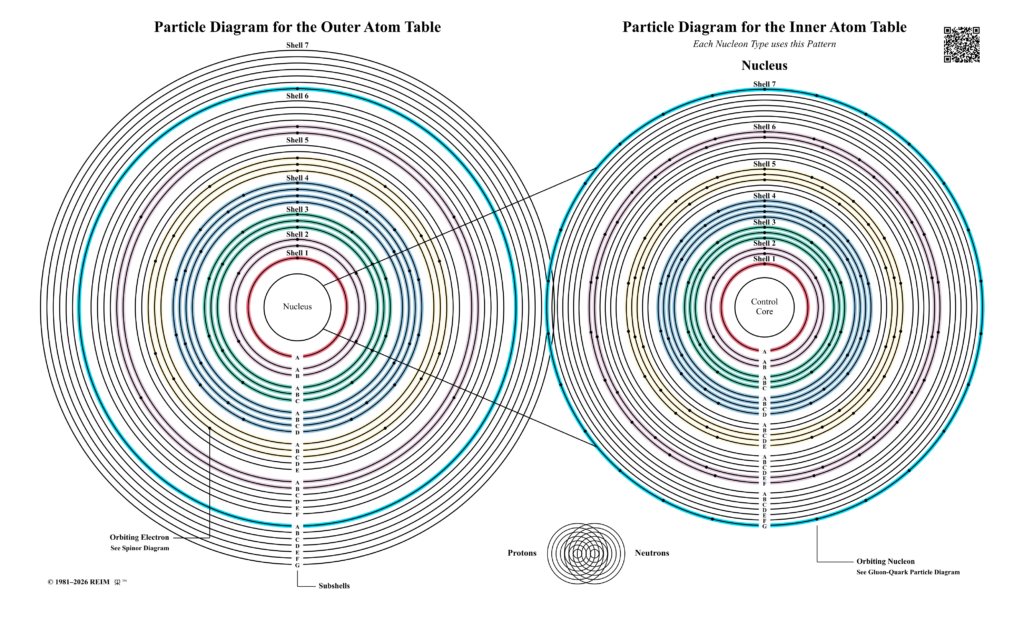
The Ring-Filling Pattern
One of the most interesting things about how electrons fill the rings (Subshells) of an atom is the pattern that emerges. The electrons begin at the innermost Subshell and generally work their way outward. However, as the atom gets larger, you begin to notice that some rings are skipped while Subshells farther out are filled first.
When we examine this sequence more closely, a beautiful symmetrical pattern appears.
Each time an electron enters a new Shell for the first time, it occupies the innermost Subshell within that Shell. As the filling continues, additional Subshells within that Shell become occupied.
By the time we reach the end of the Outer Atom Table, the pattern looks like this:
Shell 1: 1 occupied Subshell
Shell 2: 2 occupied Subshells
Shell 3: 3 occupied Subshells
Shell 4: 4 occupied Subshells
Shell 5: 3 occupied Subshells, with the outer 2 empty
Shell 6: 2 occupied Subshells, with the outer 4 empty
Shell 7: 1 occupied Subshell, with the outer 6 empty
This produces the symmetrical pattern:
1, 2, 3, 4, 3, 2, 1 — or 1234321
On the Outer Atom Table, each of these Subshell rings corresponds to one of the groups of element blocks. Subshells belonging to the same Shell have the same color, making it easy to see where each group of Subshells is located within the atom.
Now Look Inside the Nucleus
The Inner Atom Table uses the same number of Subshells within each Shell as the electron structure. In this representation of the nucleus, there are actually two corresponding sets of quantum states—one for the protons and another for the neutrons. For simplicity, the Ring Diagram can represent them as a single set of rings because the filling pattern is the same for each.
Now imagine starting with an empty nucleus and adding protons one at a time.
Something remarkable happens.
The same 1, 2, 3, 4, 3, 2, 1 pattern emerges—but with one major difference.
When a proton enters a Shell for the first time in the Inner Atom Table sequence, it begins with the outermost Subshell within that Shell and works inward. This is the opposite direction from the electron sequence represented by the Outer Atom Table.
Yet both ultimately produce the same symmetrical numerical pattern:
1234321
That difference in filling direction is why the Inner Atom Table and Outer Atom Table have different arrangements of blocks. Each table represents its own filling sequence.
Each Table IS that order.